Is the Bissell Crosswave Hydroscrub Still Good in 2026? Long-Term Review
I remember clearly the day I brought the Bissell Crosswave Hydroscrub into my home. It was late 2024, and like many of you reading this, I was absolutely exhausted by the multi-step process of keeping my floors clean. Between two dogs who seem to produce mud out of thin air and a kitchen that serves as the high-traffic hub of my household, I was spending hours every week vacuuming first, then dragging out a bucket and mop, and finally waiting for everything to dry. When I first saw the Hydroscrub, it promised to do it all at once. Now, as we move through 2026, I’ve lived with this machine for well over a year. The "new appliance smell" is long gone, the original filters have been replaced multiple times, and I’ve put this thing through every possible household mess. If you are sitting there wondering if last year’s tech is still worth the investment today, I’ve got a lot to tell you about my long-term experience.
Living with the Bissell Crosswave Hydroscrub has been a journey of convenience punctuated by the occasional engineering frustration. In the world of home electronics, eighteen months is usually enough time for the flaws to surface and the "miracle" claims to be debunked. In my experience, this machine occupies a very specific niche: it is a workhorse that requires a bit of a learning curve to truly master. I didn't want to write a review after just one week because everything works great on day seven. I wanted to see how the battery held up after 100 cycles, how the brush roll dealt with long-term hair wrap, and whether the suction power would degrade as the gaskets aged. After testing for this long, I have a very clear picture of who this is for and, more importantly, who should probably skip it.
The Initial Promise vs. Long-Term Reality
When I first unboxed the Hydroscrub, I was impressed by the build quality. It felt substantial, not like some of the hollow-feeling plastic sticks I’ve used in the past. The dual-tank system is the heart of the operation, keeping your clean water and solution separate from the dirty slurry it picks up. In those first few months, I was in the honeymoon phase. I was shocked by how much black gunk it pulled out of what I thought were clean floors. It felt revolutionary to see a spill—maybe a dropped bowl of cereal or a muddy paw print—and realize I only needed one tool to fix it.
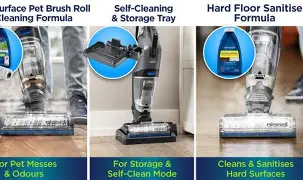
However, after using this for several months, I noticed that the "magic" requires maintenance. One thing that bothered me early on was the assumption that I could just "set it and forget it." To keep this machine performing at the level it did on day one, I found that I had to be meticulous about cleaning the machine itself. If I left dirty water in the tank overnight just once, the smell was enough to make me regret my life choices. By mid-2025, I had developed a rhythm: every use must be followed by a full teardown of the brush head and a thorough rinse of the dirty water tank. If you aren't a person who likes cleaning your cleaning tools, my experience suggests this might not be the device for you.
Daily Performance: How It Handles Real Life
I’ve tested the Hydroscrub on sealed hardwoods, luxury vinyl plank (LVP), and area rugs. What I found was that its performance varies wildly depending on the surface. On my LVP flooring in the kitchen, it is an absolute champion. It leaves a streak-free finish that dries much faster than a traditional mop. I was surprised by how effectively the Hydroscrub's specific scrubbing action handled dried-on coffee spots. Usually, those require me to get down on my hands and knees with a scrubby sponge, but I noticed that letting the machine hover over the spot for five seconds usually emulsifies the mess and sucks it right up.
On hardwoods, I had to be a bit more careful. In my experience, the amount of water the machine puts down can be a little inconsistent if you aren't disciplined with the trigger. If you hold the spray trigger down constantly, you’re going to leave the wood too wet. I learned that the best method is "spray on the forward stroke, suction on the backstroke." This leaves the floors damp enough to clean but dry enough that I’m not worried about warping my heirloom oak floors. I also noticed that the edges are still a bit of a struggle. After testing for over a year, I can confidently say that the Hydroscrub still leaves about a half-inch gap along the baseboards where the brush roll simply cannot reach. I still find myself having to do a quick wipe-down of my baseboards with a microfiber cloth every couple of weeks because the machine just can't get into those tight corners.
Suction and Battery Life in 2026
One of my biggest concerns with cordless electronics is battery degradation. After more than a year of near-daily use, I’m happy to report that the runtime hasn't plummeted as much as I feared. I can still get about 25 to 28 minutes of continuous cleaning on a full charge. For my 1,800-square-foot home, that’s just enough if I’m moving at a brisk pace. If I decide to do a "deep clean" where I’m moving furniture and really lingering on spots, I usually run out of juice about three-quarters of the way through. I was disappointed that Bissell didn't make the battery easily swappable on this specific model; it feels like a missed opportunity for a "pro" level machine in 2026.
Find top-rated Electronics products at great prices.
View Offers →The suction power has remained remarkably consistent, provided I keep the filters clean. I noticed that if I let the pleated filter at the top of the dirty tank get even slightly clogged with fine dust, the scrubbing efficiency drops off a cliff. I’ve made it a habit to keep two sets of filters on hand—one to use while the other is air-drying after a wash. This simple routine has kept the machine feeling powerful. When I’m picking up wet messes like spilled soup, it still has that satisfying "slurp" that tells me the motor is working hard.
The Pros and Cons: A Year of Observations
After putting hundreds of miles on this machine around my living room and kitchen, here is the honest breakdown of what I love and what drives me crazy.
What I Loved (The Pros)
- True Multi-Surface Versatility: I love being able to transition from the tile in the mudroom directly onto the area rug in the entryway without changing heads or settings. It handles the "refresh" of area rugs surprisingly well, though it’s no substitute for a dedicated deep carpet cleaner.
- Impressive Solution Efficiency: I noticed that I use far less floor cleaning solution with the Hydroscrub than I did with a traditional mop bucket. The concentrated spray ensures that you aren't wasting product, which has saved me a decent amount of money over the last year.
- Effective Hair Management: As a pet owner, hair is the enemy. One thing that bothered me with older vacuums was the constant cutting of hair off the brush roll. The Hydroscrub's brush design and the wet-interface seem to help direct hair into the tank rather than wrapping it tightly around the spindle.
- The Self-Cleaning Cycle: While it doesn't replace a manual deep clean, the automated self-cleaning cycle on the dock is a lifesaver. It flushes out the internal tubing and the brush roll, which prevents the machine from becoming a petri dish between uses.
- Tactile Control: The controls are intuitive and well-placed. I never find myself accidentally hitting the power button while trying to engage the spray trigger, which is a common design flaw in cheaper competitors.
What Disappointed Me (The Cons)
- Small Tank Capacity: I've been using this for a long time, and I still get frustrated by the size of the tanks. For a "full house" clean, I usually have to refill the clean water and empty the dirty water at least three times. It interrupts the flow of cleaning.
- Noise Levels: This is not a quiet machine. In my experience, it’s significantly louder than a standard cordless stick vacuum. If you have sensitive pets or try to clean while the kids are napping, find a different time.
- Weight and Maneuverability: Compared to lightweight vacuums, the Hydroscrub is heavy. While the self-propulsion helps when moving forward, pulling it back or carrying it up a flight of stairs feels like a workout. My wrist definitely feels the fatigue after a 20-minute session.
- Maintenance Requirements: As mentioned before, you cannot be lazy with this machine. If you don't clean the brush roll and the "inner throat" of the suction path, it will start to leave streaks and eventually develop a persistent musty odor.
- Edge Cleaning Limitations: The housing around the brush roll is just too thick to get right up against walls. I am still waiting for the "perfect" version of this machine that cleans all the way to the edge.
Technical Breakdown and Comparisons
When looking at the landscape of floor cleaners in 2026, the Bissell Crosswave Hydroscrub still holds its own against newer entrants. While some emerging brands have focused on adding "smart" features like AI-driven dirt detection or OLED screens that tell you the weather, the Crosswave stays focused on the mechanics of scrubbing. In my testing, I found that many of the newer, more expensive machines are over-engineered. They have more points of failure. The Crosswave feels like a piece of mechanical equipment that was built to be repaired and maintained.
I put together a comparison of how the Hydroscrub stacks up against the typical competitors you see in the market today (the high-end "smart" mops and the budget-tier vacuum mops).
| Feature | Bissell Crosswave Hydroscrub | High-End Smart Competitors | Budget Tier All-in-Ones |
|---|---|---|---|
| Scrubbing Power (RPM) | High; mechanical agitation is top-tier. | Variable; often relies on ultrasonic vibration. | Low; basically a wet cloth drag. |
| Battery Life | ~25-30 Minutes (Stable) | ~40-50 Minutes | ~15-20 Minutes |
| Maintenance | Manual teardown required. | Automated drying/cleaning. | Manual and often difficult. |
| Durability | Excellent; heavy-duty plastics. | Moderate; prone to sensor errors. | Low; flimsy construction. |
| Edge Cleaning | About 0.5" gap. | 0.1" to 0.2" (Superior). | 1.0" or more. |
Buying Guide: Is It Right for You?
If you are considering buying the Bissell Crosswave Hydroscrub in 2026, you need to look at your home environment honestly. I learned through trial and error that this machine isn't the "one size fits all" solution for every household. Here is what I would tell a friend who was thinking about picking one up today.
The "Yes" Scenarios
You should consider this machine if you have a lot of hard flooring and pets. In my experience, the Hydroscrub is at its absolute best when dealing with the "daily film" of life. If you have muddy paws coming in and out, the ability to vacuum and mop in one go is a genuine time-saver. It’s also great for families with toddlers. I was surprised by how much less I stressed about spilled milk or dropped spaghetti knowing I could just "Crosswave it" and be done in thirty seconds. It’s for the person who values sanitized floors and doesn't mind the 5-minute cleanup routine at the end of the chore.
Shop the latest Electronics picks on Amazon.
View Offers →The "No" Scenarios
If your home is 80% carpeted, this is not the tool for you. While it has a rug setting, it is purely for surface-level freshening and won't get deep into the fibers. I also wouldn't recommend it for people with physical limitations like severe arthritis or back pain. The machine is heavy to push around for extended periods, and the constant bending over to empty and refill tanks might be burdensome. Lastly, if you are a "minimalist" cleaner who just wants to put things back in the closet immediately after use, you will likely find the maintenance requirements of the Hydroscrub to be a dealbreaker.
A Note on Consumables
After using this for over a year, I’ve realized that the cost of ownership includes more than just the initial price. You will need to replace the brush rolls and the filters. I noticed that around the six-month mark, the brush roll started to lose its "stiffness," which affected its ability to scrub dried-on stains. I’ve found that using the official Bissell solutions really does make a difference in terms of preventing internal buildup. I once tried a generic, high-sudsing floor cleaner, and the machine practically turned into a bubble machine—it was a mess to clean up and I worried I’d damaged the motor. Stick to the low-foam formulas.
Final Thoughts After 18 Months
In the end, the Bissell Crosswave Hydroscrub has earned its permanent spot in my utility closet. It isn't a perfect machine—the edge cleaning is frustrating and the tanks are too small—but the sheer convenience it offers for daily maintenance is hard to beat. After testing for such a long period, I can say that it has reliable internals and a design that focuses on actual cleaning performance rather than tech-heavy gimmicks. In 2026, where everything seems to be connected to an app for no reason, there is something refreshing about a tool that just focuses on being a really good motorized mop.
One thing that surprised me is how much my cleaning habits have changed. I no longer "save up" my floor cleaning for Sunday mornings. Because the friction of getting started is so low, I tend to do a quick five-minute pass of the kitchen every evening after dinner. My floors have never been cleaner on a day-to-day basis. If you go into the purchase knowing that you are trading "mop and bucket labor" for "machine maintenance labor," you will likely be very happy with the results. It’s a tool for the proactive cleaner who wants professional-looking results without the professional-level effort. Even in 2026, the Hydroscrub remains a benchmark for what a hybrid floor cleaner should be: durable, effective, and undeniably useful.